Company Background
In March 1958, with the creation of ALIVA DE VENEZUELA C.A. as a subsidiary of ALIVA AG. from Baden, Switzerland, constitutes the beginning of the use in Venezuela, of a new and original system of shotcrete or projected concrete with many applications in the construction industry.
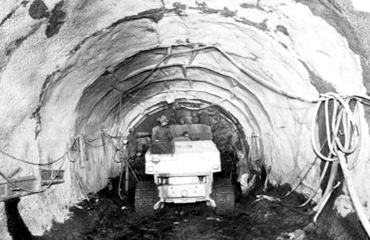
The Helicoide of Roca Tarpeya in Caracas; the railroad tunnels from Guanta to Naricual, in eastern Venezuela; the Cabrera tunnel at the Central Regional Highway; the Planicie tunnel in Caracas; the Ollas tunnel to interconnect Camatagua and Ocumarito rivers; were some of the most important woks that ALIVA DE VENEZUELA C.A. did in its first years of operations. This gave the company a high-quality standard that continues to maintain today.
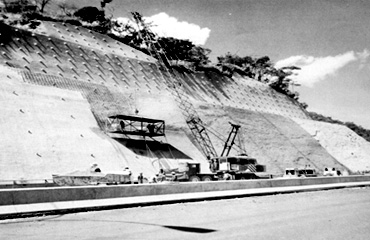
Ten years later, in 1968 STUMP DE VENEZUELA, C.A. was formed as a subsidiary of STUMP BOHR A.G. from Zürich, Switzerland. This new company innovated the use of anchored supporting systems for walls in Venezuela. This new technique was applied to important stabilization works, specifically with the development of the DUPLEX, system considered worldwide as the most advance permanent anchoring. Even today, its use constitutes the best alternative for the stabilization of the walls of deep basements, dams and slopes in communication routes. Also, its use has been extended to the stabilization of special structures. The best examples of the successful use of this technology are the anchored walls for the basements of the Central Bank and the towers of Parque Central, both of them in Caracas.
History
The Operational Merge
In February 1972, ALIVA DE VENEZUELA C.A. and STUMP DE VENEZUELA C.A. merged their operations and the first of them became ALIVA-STUMP C.A. From then on, ALIVA-STUMP C.A. assumed all activities of both companies but STUMP DE VENEZUELA C.A. subsisted as an independent company.
Development and Expansion
At the early beginning ALIVA-STUMP C.A. (as ALIVA DE VENEZUELA C.A.) had only a capital equivalent to USD 60 thousand, twenty (20) employees (including professionals, technicians & workers), and a low stock of its own equipment because most of it was rented.
Currently, Aliva Stump, C.A. has assets over USD 10 million and its operations are a stable source of work for more than three hundred (300) employees, and more than eighteen hundred (1800) workers.
Since the operational merge, but with much more emphasis in the last thirty years, ALIVA-STUMP C.A. has extended its activities to others in the construction industry, especially in the construction of industrial facilities, single-family and multi-family housing units; shopping centers, hotel establishments, etc.
The budget execution has behaved as has been the development of the construction industry in the country. The production peak in the last two decades was achieved in 1999, with an income of USD 44 million, declining until 2004. But with the construction boom in recent years, with the confidence shown by customers, has exceeded the historical record.